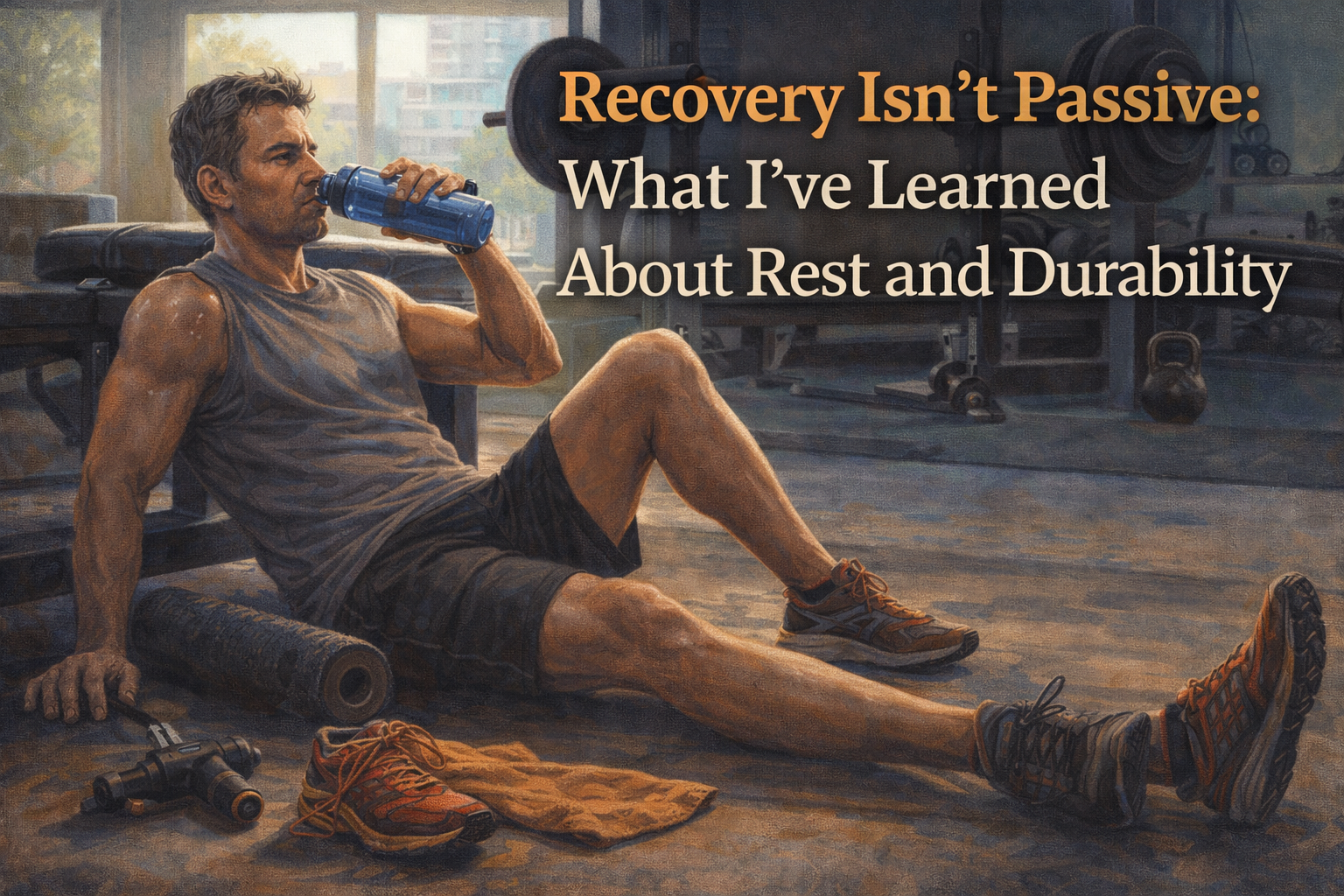
For a long time, I treated recovery as whatever happened when I wasn’t running. If the workout was done, I assumed the job was done too. The hard part was the effort itself, and the time between runs was supposed to take care of itself in the background.
That way of thinking holds up only until it doesn’t. The change is gradual at first. Legs stay heavy longer than they used to. A run that should feel ordinary takes too much out of the next day. Small aches stop behaving like passing annoyances and start acting like they’d prefer to stay. None of that looks dramatic in isolation, which is part of why it’s easy to miss.
What changed my view was realizing that durability is built less by the runs that look impressive and more by the conditions that allow training to continue without constant interruption. Recovery isn’t what happens after the real work. It’s part of the real work.
What Rest Actually Has to Do
The simplest way I can put it is this: training creates stress, and the body has to absorb that stress before the next round has any chance of being useful. Bill Bowerman said it more sharply: “The idea that the harder you work, the better you get is just garbage. The greatest improvement is made by the man who works most intelligently.” That line stays with me because it cuts straight through one of the easiest mistakes runners make, especially when things are going well.
It’s tempting to think durability comes from proving you can handle more. More mileage, less downtime, fewer concessions to fatigue. Sometimes that works for a while, particularly when momentum is high and the training block is going smoothly. But a routine can look productive and still be poorly absorbed. That’s the part that matters. Adaptation doesn’t happen during the run. It happens afterward, when the body is repairing, recalibrating, and deciding whether the stress it just received was something it can build from or something it needs to defend against.
Once I started looking at recovery that way, the standard changed. The question stopped being whether I could complete the workout and became whether I could keep training well three days later, and again the following week.
Sleep Is Not a Side Detail
If there’s one part of recovery that’s easiest to acknowledge and easiest to underrate, it’s sleep. Most runners know it matters. Fewer treat it as a genuine training variable.
The research is hard to ignore. A 2023 systematic review and meta-analysis found that sleep deprivation has a deleterious effect on endurance performance of moderate size, with longer efforts affected more than shorter ones. That lines up with experience better than almost any recovery claim I’ve seen. A poor night of sleep doesn’t always ruin a run, but it changes the margins. The run takes longer to settle. Pace feels less controlled. Effort and output stop matching the way they should.
I’ve learned to notice that difference early. When sleep has been good, there’s usually a steadier feel from the first mile onward. The body cooperates faster. When it hasn’t, everything is just a little more expensive. The pace that should feel manageable asks for more concentration, and the recovery from that run often takes longer as well.
That doesn’t mean every night has to be perfect. Real life doesn’t work that way. But it does mean sleep can’t be treated like a bonus feature of training. It’s part of what determines whether the training is being supported or undercut.
Easy Days Have to Stay Honest
One of the less obvious recovery mistakes is turning too many runs into moderate efforts. Not hard enough to count as a real workout, not easy enough to promote actual recovery. Just enough effort to keep fatigue simmering in the background.
I’ve done that more times than I’d like to admit, usually without intending to. A run starts feeling smooth, pace drifts down, and by the end of it the day has taken more than it should have. Nothing seems wrong in the moment. The problem shows up later, when the next session feels flatter than expected or the week starts carrying a low level of fatigue that never fully clears.
Keeping easy days easy requires more discipline than it sounds like it should. There’s no immediate reward in it. The run may feel almost too controlled. But over time, those are the days that let the rest of the week hold together. They preserve rhythm without quietly adding another load to a body that may already be carrying enough.
Durability depends on that honesty. If every day asks for a little too much, the cumulative effect tends to show up before the runner understands where it came from.
Recovery Changes With Age, Even When Standards Don’t
Another adjustment that becomes harder to ignore over time is that the body does not respond to the same stimulus in exactly the same way forever. That doesn’t mean improvement stops. It means the support around training has to become more deliberate.
A systematic review on age and muscle protein synthesis found evidence that the response to exercise and amino acid-based nutrition is attenuated in older adults compared with younger individuals. That’s a technical way of describing something a lot of runners feel before they could ever explain it: the same work can require more recovery than it used to, and the margin for ignoring that fact gets smaller.
I’ve come to see that less as bad news than as useful information. It changes how I think about spacing harder efforts, fueling after runs, and resisting the urge to stack demanding days too tightly. The goal isn’t to become fragile or overly cautious. It’s to understand what the body needs in order to keep responding well to training.
That’s a different mindset from simply pushing through. It’s also a more durable one.
Strength Work Counts as Recovery Support
For a while, I thought of strength training as something separate from durability. Useful, maybe, but mostly additive. Another box to check if time allowed.
That view changed when I started paying attention to what happened during training blocks where support work was consistent. The difference wasn’t flashy. I didn’t feel transformed. What I noticed instead was that the routine felt more stable. Fewer small issues built up. Fewer runs had to be reworked because something felt slightly off. Training felt less vulnerable to minor breakdowns.
That pattern fits the research. A Sports Medicine review found that strength training can improve running economy, and broader sports medicine research links it to lower injury risk through better stability and greater tolerance for load. In practical terms, that matters because recovery is not only about what helps you feel better tomorrow morning. It’s also about what makes the body more reliable across months of training.
I don’t think of that work as separate from recovery anymore. I think of it as one of the things that makes recovery more effective.
Durability Shows Up as Continuity
A strong day can hide a lot. A runner can feel sharp, hit the pace, and still be training in a way that won’t hold together. That’s why I’ve become less interested in isolated signs of fitness and more interested in patterns.
Are the runs starting to connect well from one week to the next? Are small problems resolving instead of lingering? Is the body generally ready to work again when it should be, or does every harder effort leave a longer trail than it used to? Those questions tell me more now than any single session.
That, to me, is what durability actually looks like. Not toughness in the abstract, and not some refusal to slow down when recovery is needed. It looks like continuity. It looks like being able to train with purpose, recover well enough to do it again, and keep that rhythm going without constant interruption.
The best training blocks I’ve had were not the ones where I squeezed in the most. They were the ones where the work could be absorbed. Once I understood that, rest stopped feeling passive. It started to look like one of the most active decisions in the whole process.
Bio: Scott Saffold is an endurance athlete and marathon runner. Learn more at https://www.pinterest.com/scotthsaffold/ and https://www.strava.com/athletes/204425964