A training plan can look reasonable until it meets a real week. On paper, the miles are spaced out, the long run has its place, and everything seems to fit. In practice, the week fills up quickly. Maybe my appointment schedule is especially demanding or my family was out late the night before. For a lot of us, what looked manageable on Sunday starts to feel crowded by Wednesday.
That’s usually where consistency gets decided. Not in ideal conditions, but in ordinary ones where time is limited and energy isn’t guaranteed. Most people don’t struggle because they don’t know how to train. They struggle because fitting training into a full life requires more structure than the plan itself suggests.
Surveys in public health research consistently show that lack of time is one of the most commonly reported barriers to regular exercise. That lines up with experience. The issue isn’t awareness. It’s the friction created by everything else competing for the same hours.
What’s worked for me is accepting that time doesn’t open up on its own. It has to be arranged, often in small ways that don’t seem important in the moment but determine whether the run actually happens.
Why Early Mornings End Up Doing the Heavy Lifting
Early mornings aren’t appealing because they feel good. Most days, they don’t. They work because they’re less exposed to disruption.
By the afternoon, the day has already taken shape. Meetings change, responsibilities pile up, and energy drops. Even a well-planned run can disappear without much resistance. Morning running avoids most of that. It happens before anything else has had a chance to interfere.
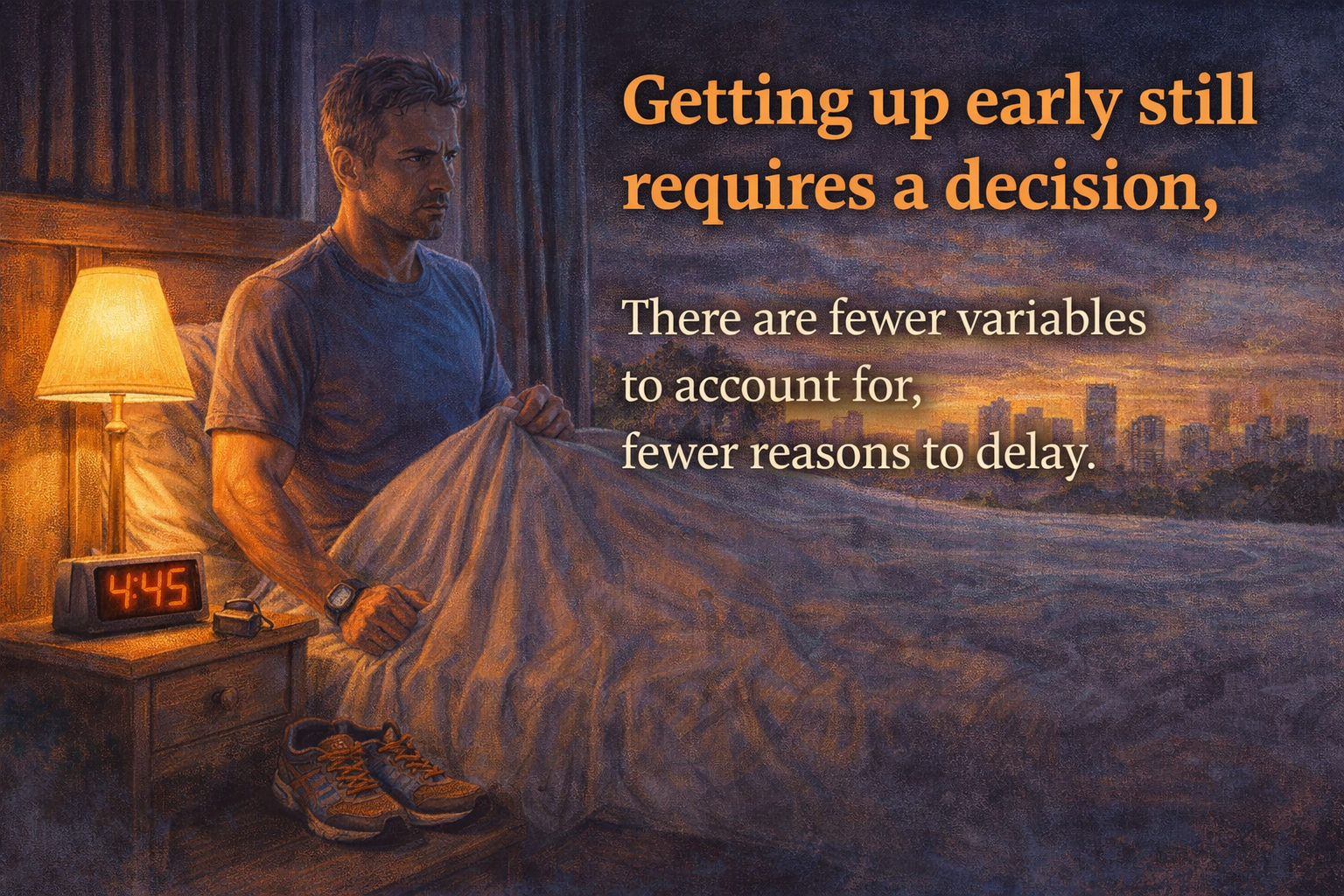
That doesn’t mean it’s automatic. Getting up early still requires a decision, especially on days when sleep feels short. But it’s a cleaner decision. There are fewer variables to account for, fewer reasons to delay.
Gradually, that reliability becomes more valuable than convenience. A run that happens consistently at a less-than-ideal hour tends to matter more than one that depends on everything lining up later in the day.
The Night Before Is Part of the Run
Early training doesn’t start in the morning. It starts the night before.
Sleep plays a larger role than most people expect. Research has shown that sleep deprivation can impair endurance performance, including reducing time to exhaustion and overall output. That shows up quickly in training. A short night doesn’t just make a run feel harder. It can change how the entire effort unfolds.
I’ve learned to treat the evening as part of the run itself. Not in a rigid way, but in a practical one. Going to bed earlier when possible, keeping things simple, prepping the night before for the morning’s run, and avoiding decisions that make the next morning harder than it needs to be.
Long Runs Need Edges
A long run isn’t just a block of time. It has edges that extend into the rest of the day.
Without some planning, it can feel like it competes with everything else. The run itself might go well, but the hours around it feel compressed or rushed. That’s usually a sign that the run hasn’t been integrated into the day—it’s been dropped into it.
I’ve found that long runs work better when they’re treated as part of a larger sequence. The night before is quieter. The route is familiar. The finish point makes sense in the context of the rest of the day. Recovery isn’t an afterthought.
Bill Squires, the longtime running coach, once said, “The long run is what puts the tiger in the cat.” The line stays with you because it reflects something practical. Long runs don’t just build endurance. They shape how you organize effort over time, including everything around the run itself.
When the Week Doesn’t Cooperate
Even with structure, some weeks don’t hold together cleanly. You have to travel out of state for a business meeting, or work stretches longer than expected. Maybe your sleep falls short. In these situations, a planned run no longer fits where it was supposed to.
Trying to force the original plan into those weeks usually leads to frustration. What’s worked better for me is adjusting without stepping away from the routine entirely.
That might mean shortening a run or moving it to a different day. It might mean accepting a slower pace when energy isn’t there. The important part is staying connected to the pattern.
I’ve had weeks where none of the runs looked the way they were written. Those weeks still counted. Not because they were ideal, but because they kept the routine intact.
What Makes It Sustainable
You’ll probably find that the structure becomes more important than any individual run. As I see it, the goal isn’t to execute every session perfectly. It’s to keep the training integrated into the rest of my life in a way that can continue.
All this has required me to set some boundaries. Running has its place, but it isn’t the only priority. If it starts to crowd out everything else, it usually doesn’t last.
The weeks that hold together best are rarely the ones with the most intensity. They’re the ones where the basics were handled well enough to keep things moving. A reasonable bedtime. A protected morning. A long run that fits into the day instead of taking it over.
That’s what makes it all fit. Not perfect conditions, and not unlimited time. Just a structure that allows training to continue, even when the rest of life stays full.Bio: Scott Saffold is an endurance athlete and marathon runner. Learn more at https://www.facebook.com/scott.saffold.3 and https://www.instagram.com/scott.la.doc/